
Every time someone mentions Low-Carb High-Fat (LCHF), two questions immediately come up:
“Is it safe?”
“Can anyone really follow this long term?”
Fair questions. Because for decades we were told:
- fat is dangerous
- carbs are essential
- eating frequently is healthy
So, when LCHF challenges these ideas, it feels uncomfortable. Let’s break this down and separate fear, myths, and facts using physiology, clinical experience, and science.
First, What Is LCHF? and What It Is NOT.
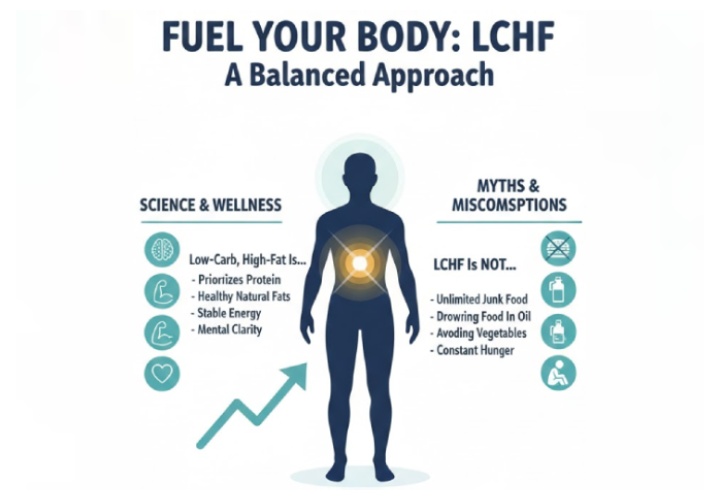
LCHF is not:
- eating unlimited junk food.
- drowning everything in oil.
- avoiding vegetables.
- starving yourself.
LCHF is:
- reducing refined and excess carbohydrates.
- prioritising protein.
- eating natural fats (ghee, butter, coconut, nuts).
- stabilising blood sugar and insulin.
At its core, LCHF is blood sugar and insulin management, not a trend.
The Big Safety Question: Is LCHF Safe?
Short answer: Yes! when done correctly and appropriately.
Human beings have thrived for millennia on a wide range of carb intakes. There is no biological requirement for high carbohydrate intake.
The question which comes in mind is, what is biologically required?
- essential amino acids (protein).
- essential fatty acids (fat).
There is no essential carbohydrate. This alone should make us pause and rethink.
Following are the Myths and realities
Myth #1: “Your Brain Needs Carbs”
This is one of the most common fears.
Reality: Your brain needs energy, not carbohydrates.
When carbs are low:
- the liver produces ketones
- ketones fuel the brain efficiently
- blood sugar is still maintained via gluconeogenesis
This is normal human physiology and not starvation.
That’s why many people report:
- better focus
- reduced brain fog
- stable energy
when on LCHF.
Myth #2: “LCHF Is Dangerous for the Heart”
This fear largely comes from outdated fat-cholesterol assumptions.
What science actually shows
LCHF consistently improves:
- by lowering triglycerides.
- Increasing HDL cholesterol.
- triglyceride/HDL ratio (a strong heart risk marker)
Some people may see LDL cholesterol rise initially, but:
- particle size often shifts to larger, less harmful LDL
- inflammation markers usually improve
Heart disease risk is more strongly linked to insulin resistance and inflammation than fat intake alone. LDL should not be seen in isolation. I have written another detailed article on cholesterol in the blogs section.
Myth #3: “LCHF Is Only for Weight Loss”
Weight loss is just one positive side effect.
LCHF has been shown to help with:
- insulin resistance.
- prediabetes & type 2 diabetes.
- PCOS.
- fatty liver.
- metabolic syndrome.
- constant hunger & cravings.
For many, metabolic healing happens even before major weight loss.
What About Long-Term Sustainability?
This is the most important question.
The truth: Any diet is unsustainable if it feels like punishment.
LCHF becomes sustainable when:
- it reduces hunger.
- it improves energy.
- it removes constant food obsession.
- it fits cultural food patterns.
Many traditional Indian foods are naturally LCHF-friendly:
- ghee, butter
- curd, paneer
- coconut, peanuts
- vegetables
- eggs, fish, meat
- buttermilk
The problem isn’t per se with the Indian food. The problem is when we have modern carb overload in addition to ultra-processed foods.
Common Mistakes That Make LCHF Feel Unsafe
LCHF can feel “bad” when done incorrectly:
❌ not eating enough protein
❌ cutting carbs but fearing fats
❌ ignoring electrolytes (salt, potassium)
❌ undereating calories
❌ jumping in too aggressively
These are implementation issues, not flaws in LCHF itself.
Who Needs Medical Supervision on LCHF?
LCHF is safe for most people, but medical guidance is important if you have:
- diabetes on insulin, sulfonylureas or other anti-diabetic therapies..
- blood pressure medication.
- chronic kidney disease.
- eating disorder history.
This is not because LCHF is unsafe but because medications often need reduction as insulin sensitivity improves. LCHF is a great vehicle if you want a pill free journey of life!
The Indian Context: Why LCHF Often Works Better Here
Indians tend to have:
- higher insulin levels.
- lower muscle mass.
- more visceral fat.
- earlier metabolic dysfunction.
High-carb diets hit us harder.
LCHF often feels:
- more stabilising.
- more energising.
- less hunger-inducing.
because it matches our metabolic reality better.
Sustainability Isn’t About “Forever”, It’s About Flexibility
Sustainable LCHF does not mean:
- never eating carbs again
- avoiding social food forever
It means:
- using carbs intentionally, not constantly
- building metabolic flexibility
- returning to low-carb as your metabolic base
Think of LCHF as a metabolic reset, not a punishment or a prison.
Conclusion: LCHF Is Safe When Understood, Sustainable When Done Right
LCHF isn’t extreme. What’s extreme is our modern diet:
- sugar everywhere
- refined carbs at every meal
- insulin high all day
When insulin calms down:
- hunger calms down.
- inflammation calms down.
- weight calms down.
LCHF doesn’t fight your body. It works with it.
And that’s why for many it’s not just safe… it’s liberating.
Contact us NOW! to help you manage your issues related to metabolic disorders effectively, reduce the pill burden and let the world notice you in your new avatar!
Leave a Reply