
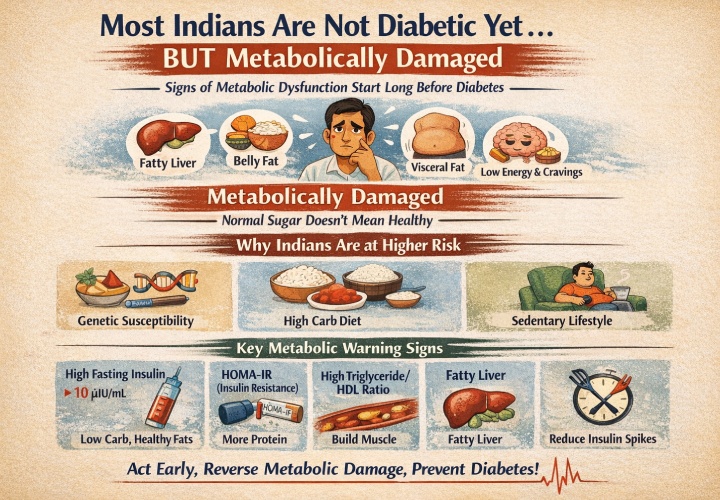
For many Indians, the first serious conversation about health begins only when diabetes finally appears on a lab report. Until then, we are comforted by familiar reassurances: “Sugar is normal.”
“HbA1c is fine.” “Just lose a little weight.”
But beneath these reassuring numbers, something else is often brewing.
Diabetes is not the beginning of metabolic disease. It is the final warning sign which comes after 15 to 20 years of unhealthy lifestyle.
Years before blood sugar rises, the metabolism is already under strain quietly, invisibly and progressively without any obvious symptoms.
What Does “Metabolically Damaged” Mean?
Being metabolically healthy is not about body weight alone. A person is metabolically unhealthy when the body:
- Requires excess insulin to manage normal blood sugar
- Stores fat easily but struggles to burn it
- Develops fatty liver despite modest eating
- Experiences energy crashes, cravings, and brain fog
This condition is driven by chronic hyperinsulinemia persistently high insulin levels. And this is where Indians are uniquely vulnerable.
Why Indians Are at Higher Risk — Even Without Diabetes.
Indians develop metabolic dysfunction in following situation where their western counterparts do not, like,
- Lower body weight
- Lower BMI
- Younger age
Several contributory factors are as follows.
1. Genetic & Epigenetic Susceptibility.
Indian populations tend to have:
- Lower muscle mass
- Higher visceral (abdominal) fat
- Reduced metabolic flexibility
This means excess carbohydrates are more likely to be converted into fat rather than used as fuel.
2. High-Carbohydrate Dietary Pattern.
The traditional and modern Indian diet is dominated by:
- Refined grains
- Frequent meals
- Sugar in beverages
- Low protein intake
This creates repeated insulin spikes throughout the day, leaving insulin elevated for years.
3. Sedentary Lifestyle + Poor Protein Intake
Low resistance training and inadequate protein worsen insulin resistance by reducing muscle, the primary glucose sink.
Why “Normal Sugar” Can Be Misleading.
Most routine health checkups focus on:
- Fasting glucose
- HbA1c
These markers rise late in the disease process. By the time glucose becomes abnormal:
- Insulin has been elevated for years
- Fatty liver may already be present
- Inflammation is established
In short:
Blood sugar rises only when insulin can no longer cope.
The Blood Markers That Reveal Early Metabolic Damage
To understand true metabolic health, we must look beyond sugar.
1. Fasting Insulin
This is one of the earliest indicators of metabolic stress.
- Optimal: <6 µIU/mL
- Concerning: >10
- High risk: >15–20
High fasting insulin means the body is constantly in fat-storage mode.
2. HOMA-IR (Insulin Resistance Index)
Calculated using fasting glucose and insulin.
- Optimal: <1
- Early insulin resistance: 1.5–2
- Significant resistance: >2.5
This marker often identifies risk years before diabetes.
3. Triglyceride to HDL Ratio
A powerful yet underused marker in Indians.
- Ideal: <2
- High risk: >3
- Severe metabolic dysfunction: >4
High triglycerides reflect excess carbohydrate conversion to fat in the liver.
4. Liver Enzymes & Fatty Liver Indicators
Mildly elevated ALT, low AST/ALT ratio, and high triglycerides often point toward insulin-driven fatty liver disease.
Fatty Liver: The Metabolic Warning Light
Non-alcoholic fatty liver disease (NAFLD) is not a liver problem. It is a metabolic problem. Fatty liver develops when the liver is overwhelmed by:
- Excess glucose
- Excess fructose
- Excess insulin
The encouraging truth? Fatty liver is highly reversible when insulin levels are reduced.
Why Calorie Restriction Alone Fails
Most advice still focuses on:
- Eating less
- Exercising more
- Reducing fat intake
But metabolic damage is not caused by calories alone. It is driven by hormonal dysregulation, especially insulin.
Without lowering insulin:
- Fat loss stalls
- Hunger increases
- Energy crashes persist.
Fixing the Root Cause: Restoring Metabolic Health
The goal is not just lower sugar it is to lower insulin.
Key principles include:
- Reducing refined carbohydrates and sugars
- Prioritising adequate protein
- Including healthy fats for satiety
- Building muscle through resistance training
- Allowing time between meals for insulin to fall
This is why Low-Carb, Healthy-Fat (LCHF) approaches work so effectively for metabolically unstable individuals. They address the cause, not just the symptoms.
The Takeaway
If you are Indian and your report says:
- “Sugar is normal”
- “HbA1c is fine”
That does not automatically mean you are metabolically healthy.
Metabolic damage often begins silently — years before diagnosis.
The good news?
When detected early, metabolic dysfunction is predictable, measurable, and reversible. The key is knowing what to look for and acting before diabetes arrives.
What the Science Shows.
Research over the last two decades consistently shows that insulin resistance and hyperinsulinemia precede type 2 diabetes by many years especially in South Asian populations.
Key evidence includes:
- South Asians develop insulin resistance and type 2 diabetes at lower BMI and waist circumference compared to Western populations.
(Yajnik CS. Diabetologia, 2002; Misra & Khurana, Journal of Nutrition, 2008) - Elevated fasting insulin and HOMA-IR predict future diabetes and cardiovascular risk even when glucose levels are normal.
(Kraft JR; Reaven GM. Diabetes, 1988; Diabetologia, 2005) - High triglyceride-to-HDL ratio is a strong marker of insulin resistance and metabolic syndrome, particularly in Asians.
(McLaughlin et al., Circulation, 2005) - Non-alcoholic fatty liver disease is now recognised as a hepatic manifestation of metabolic syndrome, driven primarily by insulin resistance.
(Targher et al., Journal of Hepatology, 2010) - Dietary carbohydrate restriction improves insulin sensitivity, triglycerides, fatty liver, and glycaemic control independent of calorie reduction.
(Volek et al., Nutrition & Metabolism, 2009; Hallberg et al., Diabetes Therapy, 2018)
If you’d like help understanding your metabolic markers or learning how to reverse insulin resistance safely and sustainably, you can explore our programs or get in touch.
Leave a Reply